
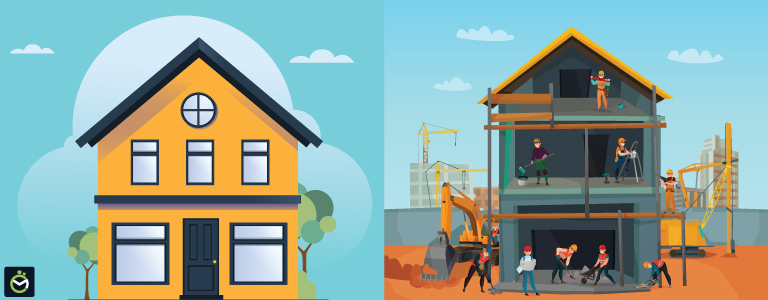
Home Construction Loans vs. Regular Home Loans

Deciding how to finance your home can feel like a big puzzle. Do you build from scratch with a home construction loan, or pick up a finished house with a regular home loan? Let’s talk it through in plain, friendly terms.
1. What Is a Home Construction Loan?
Imagine you own (or plan to buy) a plot and want to build your dream home step by step. A home construction loan gives you money in pieces, as you complete each stage—foundation first, then walls, then finishing touches. You pay interest only on the amount you’ve drawn so far. It feels more flexible, since you’re not paying interest on money you haven’t used yet. Because the house isn’t there at the start, the construction loan rate of interest may be a tad higher than a regular loan. But you get funds exactly when you need them.
2. How Stage Disbursement Works
With a home construction loan, think of funds arriving like building blocks:
- First block: money for the foundation.
- Next block: funds for the main structure.
- Final block: cash for finishing work.
After each milestone, you request the next tranche. Interest is charged at the agreed construction loan rate of interest only on what you’ve already taken. This setup in home construction financing keeps early costs lower and matches money to work done. It’s like paying for groceries as you add items to your cart, instead of paying for the whole store at once.
3. Understanding the Construction Loan Rate of Interest
Lenders look at a few things to set your construction loan rate of interest:
- Your credit score and income: A solid score and steady income help you get friendlier rates.
- Building plans and permits: Clear, approved plans reassure lenders they know what you’ll build.
- Plot paperwork and location: A clean title and a good neighborhood reduce risk.
- Loan vs. total cost: Borrowing less compared to overall building cost can improve terms.
Because the home isn’t ready at the start, lenders view it as riskier, so a home construction loan often carries a slightly higher rate than a regular home loan. It pays to compare offers and check other home building loans or home construction financing options to spot the best deal.
4. Documents and Eligibility
Before applying for a home construction loan, gather essentials:
- Approved building plan and all permits.
- Proof you own (or will buy) the plot.
- Detailed cost estimates or a contractor agreement.
- Income proof (salary slips or tax returns) and credit history.
Having these ready signals to lenders you’re organized. Clear paperwork and a good credit score smooth the path. It’s like showing you’ve packed everything before a trip—no last-minute panic.
5. EMIs and Repayment
During construction, many lenders ask for interest-only EMIs on what you’ve drawn. After your home is built, the loan converts to full EMIs on the total amount you used. Try an EMI calculator: plug in the construction loan rate of interest, your chosen tenure, and see how smaller payments now become a full EMI later. Regular home loans, by contrast, start full EMIs right after you get the lump sum for a ready house.
6. Quick Comparison
| Feature | Home Construction Loan | Regular Home Loan |
| Purpose | Build your own home in stages | Buy a ready-to-move home |
| Disbursement | Funds released stage by stage | Full amount at once |
| Interest Calculation | Interest only on drawn funds at construction rate | Interest on full sum from the start |
| Rate | Often a bit higher due to construction risk | Generally lower |
| Documentation | Plans, permits, cost estimates | Sale agreement, clear title |
| EMI Start | Interest-only EMIs initially | Full EMI from disbursal |
| Flexibility | Funds as needed in home construction financing | Lump sum; extra funds need refinance |
| Tax Benefits | Apply after completion | Immediate deductions on ready purchase |
7. Pros and Cons
- Home Construction Loan Pros:
- You shape the home your way, stage by stage.
- Early interest costs stay lower since you pay only on drawn amounts.
- Cash flow matches work done—no paying for unused funds.
- You shape the home your way, stage by stage.
- Home Construction Loan Cons:
- The construction loan rate of interest may be a bit higher.
- You handle planning, permits, and periodic checks.
- The construction loan rate of interest may be a bit higher.
- Regular Home Loan Pros:
- Lower rate and simpler steps for a ready home.
- You move in sooner and start full EMIs right away.
- Lower rate and simpler steps for a ready home.
- Regular Home Loan Cons:
- No chance to design from scratch—limited to existing layouts.
- Big renovations need separate funding later.
- No chance to design from scratch—limited to existing layouts.
8. Which One Fits You?
- Go for a home construction loan if:
- You own (or will buy) a plot and want to build your ideal home.
- You’re okay managing construction stages and interim EMIs.
- You like matching funds to work in home construction financing.
- You own (or will buy) a plot and want to build your ideal home.
- Choose a regular home loan if:
- You prefer a ready-to-move house with fewer steps.
- You want a simpler process and often lower initial rate.
- You only plan small upgrades later, funded separately.
- You prefer a ready-to-move house with fewer steps.
Conclusion
Talking it out helps: a home construction loan releases funds in steps, charging interest only on what you draw at each build phase. A regular home loan gives a lump sum for a finished house, usually at a lower rate. Compare offers, run EMI estimates, and get documents in order early. If building your dream home sounds exciting and you’re ready for stage-wise funding at a slightly higher construction loan rate of interest, a construction loan fits. If you want simplicity and quick possession, a regular home loan may be better. Pick what feels right for your plan and budget—then move ahead with confidence.